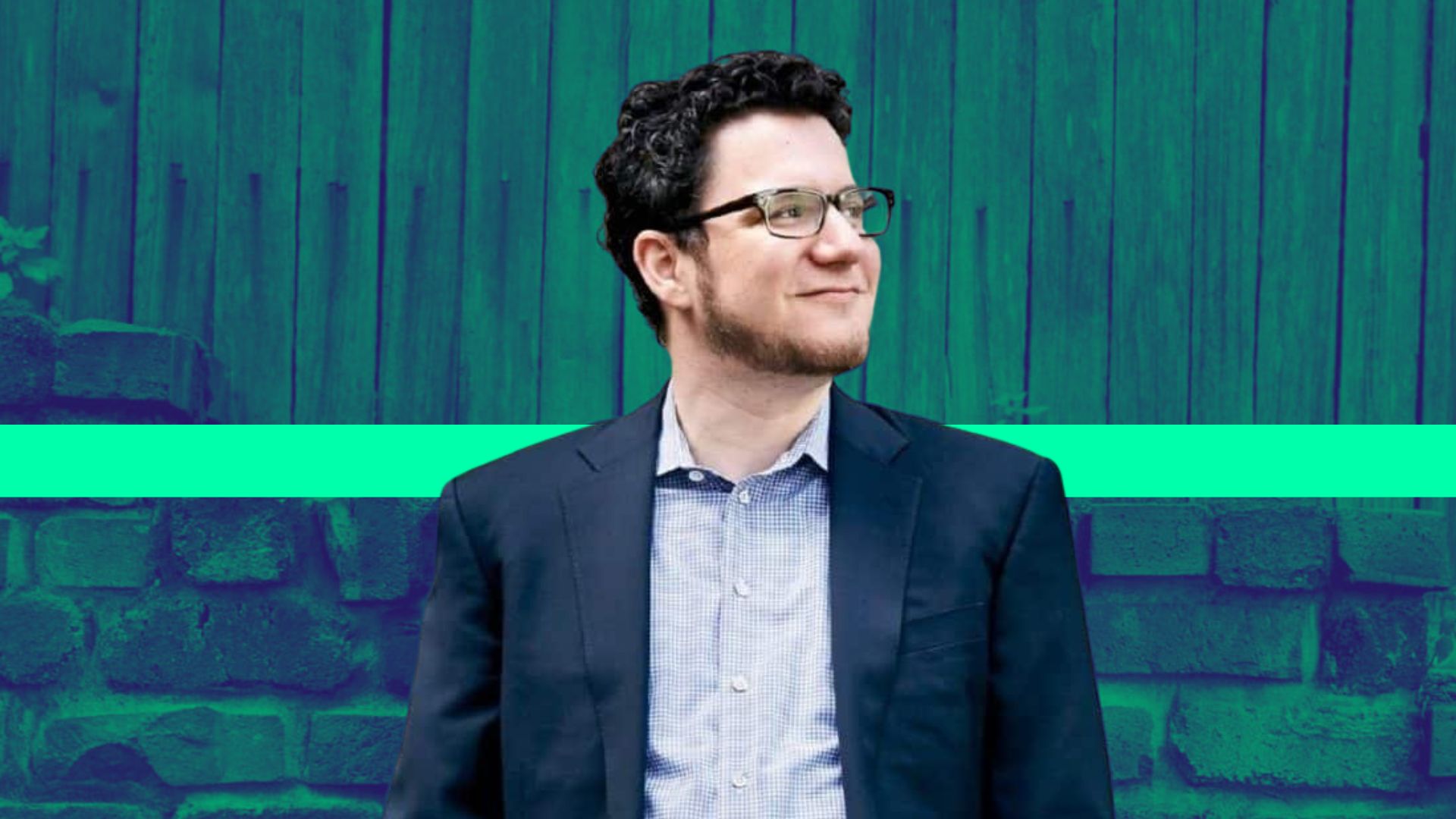
 Eric Ries’s The Lean Startup is undeniably one of the most influential writings on entrepreneurship in the last decade.
It gave a whole generation of founders a new way to build – and made ‘pivot’ a household word.
Now he’s tackling an even harder subject, an enduring mystery that’s plagued some of capitalism’s greatest success stories: Why do so many great companies eventually betray everything they stood for? And what can founders do to stop it?
In his new book Incorruptible, Ries argues that governance is the most powerful and most underappreciated force in business. In this conversation with Carlos, they get into why shareholder primacy destroys brands, why the tools to resist that pressure already exist, and why most founders give away the thing that matters most.
Listen to or read our conversation with Eric below — and buy here.
Carlos: Eric, welcome. Many people will know you as a founder and author. You’ve had quite a career. You went to Yale, worked in engineering, were a VP of Eng, built companies, written several books, and you’re now the founder of LTSE, which we’ll come to later. Before we get into the new book, I just wanted you to unpack that journey, because it is not a conventional one.
Eric: I’ve never been one of those people who can just do only one thing. I have a learning orientation, and I’ve always felt like entrepreneurship is one of the truth-seeking disciplines, like being a scientist or an artist, where you can get ever closer to the truth. I’ve always had a love of ideas, a love of learning, a love of understanding. When I first became a computer programmer as a kid, I thought I had discovered the most powerful force in the universe. I was like, “They’ll pay you to do computer programming? I thought I was going to have to pay them.” The idea that you could take something straight from your mind and make it real in the world felt like writing, but even more so. You write just the right words, and then things happen in the world. It was intoxicating.
Over time, as I tried to use this power for something, I kept encountering more and more powerful forces. I realised it’s not just about technology, but about products. Not just about products, but about platforms. And eventually, as I became an entrepreneur, I came to understand that since technology is built by people, management is a much more powerful force. One way to think about the entire Lean Startup era is simply me trying to develop and put into practice, myself before I ever asked anyone else to do it, a comprehensive theory of management, one that could include the high-uncertainty tasks of entrepreneurship into the classic general management canon.
I think not just me, but a whole group of us who were the Lean Startup movement succeeded in that project. But if you have success as a manager and leader, you will eventually start to encounter a more powerful force. That’s kind of been the layers of my career: realising there’s always more underneath, diving in, understanding it for my own sake, using it in my own companies and the companies I touch, and eventually writing about it and sharing it with others.
Carlos: You’ve left me at a cliffhanger. If tech was the first powerful force you encountered, and management was the next, what came after that?
Eric: Before I name it, let me explain where it comes from. First, I would help people build remarkable companies and then watch them get totally dismantled as they got bigger. I used to think that having your company fail was the worst thing that could happen to you as an entrepreneur, that was one of the first and most terrible things that happened to me. But I have learnt since that there are fates far more terrible than failure. There are companies where their very success becomes the beginning of their undoing. They become bureaucratic. They get away from their founders, or the founder gets fired.
Meanwhile, thanks to the success of Lean Startup, I was being asked to consult with every kind of company you can imagine. Every sector, geography, industry, size, I’ve probably done it. It was like being given the privilege to go backstage and see how business is really conducted. And in that world, there is a similar darkness.
I was there when two of our iconic major American public companies were attacked by outside activists. I got to watch that process up close, and I got to see the corruption on both sides. I started to meet leaders at every level, from the factory floor to the middle manager to the C-suite to the CEO to the board to the long-term investors. And you get the feeling from everybody that there’s this force, I call it the force that no one controls but everyone obeys, driving them to be more extractive, more short-term in their thinking.
I was really grappling with what is happening. The companies I was working with, both growing startups and companies doing transformation, would make as much progress as you can make with management, and then something at the board level would snap its fingers and make it go away. I started to realise that what happens at the governance layer is more powerful than what’s happening at the management layer.
The companies I was working with would make as much progress as you can make with management, and then something at the board level would snap its fingers and make it go away. I started to realise that what happens at the governance layer is more powerful than what’s happening at the management layer.Eric Ries ~
Carlos: That is exactly the point. Here in the UK, the political class calls it “the blob,” the reason why certain things don’t happen in politics. Governance, in a form, is that blob. It’s that bureaucratic glue that sometimes coheres a lot of different elements of good intentions into something unsurmountable. You do a great job of unpacking it in the book. Let me ask you a slightly controversial question on this topic. Reading it, I would argue it’s equal parts leadership and equal parts tackling this powerful force of governance. Would you say that’s fair?
Eric: Yes. Today we see operations and governance as two separate spheres or disciplines that interact only rarely, at the board meeting. Most managers and leaders, if I ask them a governance question, they have no idea what I’m talking about. Governance has its own jargon, its own preoccupations. I have a pop quiz in the book: if a company has a classified board, does that lead to greater or less entrenchment? Most leaders, even at the C-suite level, are like, “What are you talking about? I don’t even know what those words mean.” Whereas everyone in the governance class would know not only what the question means, but the orthodox answer to it. Interestingly, the orthodox answer is totally wrong, but we’ll get to that.
On the flip side, if I go to most boards and quiz them on the details of how the company is actually run, they can’t answer those questions. If I ask something like, “To what degree does engineering and marketing express the same values in their work?” they’ll say, “Why are you asking me?” If I say, “If a customer calls into the customer service hotline with a complaint that is technically within the letter of our terms of service, not our problem, will the customer service agent help them or hang up on them?” Boards are like, “These are questions for operators.” And yet I think this is totally wrong.
In the book, I lay out what I call the new governance, a new theory of governance for the new century that is about blending these elements together. But even within that blend, you’re right that the blueprint this book advocates for requires two things to happen. The techniques are broadly speaking inner techniques, about the internal coherence and alignment of the enterprise, and external-facing things that have to do with the structural integrity of the enterprise.
One of the ideas I want to plant in people’s heads is a new dimension to think about an organisation. Not is it good or bad, not is it profitable or unprofitable. The first question is: is it weak or strong? And what does it mean for an organisation to be strong? That’s one of my main preoccupations in the book.
Carlos: That’s helpful context for this next question, and I promise it’s the only provocative one. I wanted to ask it from a sceptical point of view, just so that anyone who’s cynical stops to reconsider. If you look at what governance is, it’s usually lumped in with societal and environmental impact, which in examples like Patagonia is tied heavily to their values. But over the last three years, retail investor net flows are moving away from ESG-labelled funds. ESG as a global index has dropped massively: $36 billion in 2024, $8.6 billion in Q1 2025. More closures of ESG funds in Europe than launches in 2024. A cynical person would say this governance stuff is just a waste of time. What did we get wrong with ESG version 1.0?
Eric: ESG is an intellectually incoherent movement that is attempting to address a very real problem and, at the same time, an almost unimaginably huge market opportunity, all in the same thing.
Let’s talk about why the E, the S, and the G are fighting with each other. If you look at the governance rating scores, what do you need to do to get a high G score? You have to do things that are antithetical to having a high E score. Companies that have some kind of mission guardian, some long-term-oriented protection against the whims of the market, are considered to have bad governance. But if you look at the track record of companies that have a genuine environmental sustainability component, they almost all have this mechanism. So it’s impossible to get a high ESG score because the two things are contradictory. Patagonia is a private company, so it can’t be rated on an ESG metric, but if it were, it would have the lowest possible governance score and the highest possible environmental score. We treat these things as separate concerns when obviously they are one integrated concern.
The second problem is that we have built an unbelievable greenwashing machine. People have become incredibly cynical about ESG, and a big part of the reason is that we treat environmental and social activities as separate from, and separable from, making a profit. In a highly financialised economy, anything separated from making a profit becomes a subsidiary goal instead of a primary goal. But looking at companies like Patagonia, the mission orientation is the engine that creates the profit. Separating them is a huge mistake.
I tell founders today: if you have any non-financial goal whatsoever, as lofty as Patagonia’s “Earth is our only shareholder,” or as humble as “I just want to create a great product, I believe in quality, I believe in health,” you are a business revolutionary whether you know it or not. Because we live in the era of shareholder primacy, which holds that the essential purpose of an organisation is not to be a beautiful living organism that makes quality products. It is merely a financial instrument designed to enrich itself and its shareholders. Which means if you have a mission statement to make a quality product, but your legal documents reflect shareholder primacy, then you are lying about the company’s mission, to your employees, to your customers, and to yourself. When push comes to shove, that mission can be abandoned instantly if investors demand it.
"If you have a mission statement to make a quality product, but your legal documents reflect shareholder primacy, then you are lying about the company's mission, to your employees, to your customers, and to yourself. When push comes to shove, that mission can be abandoned instantly if investors demand it."Eric Ries ~
But the third issue is a massive market demand, a generational shift. Among younger people, and it’s now starting to extend to people under 50, the era of shareholder primacy is already over. The idea that you should go and work at a company and be loyal to it no matter what it does in the world, that values are just decoration you slap onto a company to make the marketing a little better, younger people simply do not believe this. They don’t give institutions the reflexive deference we were raised to have. Why not? They have lived through nothing but an era of institutional collapse.
What you’re seeing with ESG inflows, the enormous amount of money desperate to be invested in a values-aligned way, we have far more demand for that than we have actual financial products that can authentically fulfil it. It is urgently needed to develop new financial products, amongst the many other things that have to happen for this movement to succeed.
Carlos: There are a lot of good ideas in the book that unpack what you’ve just said, especially around shareholder primacy, and we’ll come back to that. But I wanted to start the conversation about the book’s structure by reading a quote from the very end, which I think is apropos for anyone thinking about reading it: “This book has been littered with open secrets and hidden truths. Which of these you choose to perceive is up to you. You are the arbiter of their meaning and their impact. Perhaps you will use these tools to build a new and vibrant future. Excellent. But perhaps you have realised that each one can also be used in reverse. Is financial gravity a force to be reckoned with or a way to get ahead? If you wish, you may use these words in that way. You’re living and do not need my blessing, but I give it anyway. Do what you need to do.”
Eric: Nobody ever quotes from the end of the book. That’s exciting.
One of the things I’ve learnt about books is that it’s a power law distribution how far people get. If you look at the histogram, it has significant decay. I used to get upset that nobody read the end. I put just as much work into it as the beginning, maybe more. But then I realised it’s a gift. The people who make it to the end are special. I conceived of this book as a journey, knowing people would drop off along the way. As a literary device, that gave us great freedom to break the conventions of the genre as we go. The book begins like a business book, but it does not end that way.
The key idea, having worked on these issues for a long time with many founders, leaders, board members, and CEOs, is that it’s not really worth my time to try to convince anybody to do the right thing. If somebody wants to build a company that will be around in 100 years, I will do anything to help them. But sometimes you say to people, “We have the data: if you want your company to live 50 years or longer, you are five times more likely to succeed if you follow the recommendations in this book.” And some people say, “I don’t care about that. I just want to make a quick buck.” I know those people exist.
I think we do way too much moralising about the behaviour of the least powerful people in our society and far too little about the most powerful. If someone is struggling financially and wants to make a buck, who am I to say don’t? But a lot of people have depth to their goals. They want to create something really powerful, change the world for the better, see their values realised. It’s to those people that I owe my loyalty and allegiance. My goal with the book is to give them the tools they need to defend that insight.
I happen to think the data suggests, and my own experience absolutely convinces me, that people who are authentically aligned with the goal of promoting human flourishing have an advantage over the extractors and the exploiters. The magnetic alignment you get when people feel that what you are proposing fills their deepest needs and longings, those people ultimately have an advantage.
But a lot of people look around and say, “It seems like extraction and exploitation leads to getting rich and powerful and famous. I want that too.” Do those people seem happy to you? They don’t seem very happy to me.
One of the big fallacies we discuss in the book is that when you look at the world and see things the way they are, we often assume that’s the invisible hand of the market at work. The market selects for value creation. So if everyone’s exploiting, that must mean exploitation is the more profitable path. But the data does not support this. A lot of places where you see unanimity of behaviour reflect not value creation or some market mechanism, but the intentional structuring and engineering of our economy to reward those specific activities, and even to punish people who deviate from these orthodox best practices. That’s why so much of the book is about what you should do when someone comes to you wielding best practices. Generally speaking, what you should do is run for the hills and learn to think for yourself.
Carlos: It’s funny you should say that, because in that quote, you present the leader with a duality of choice. You give an example in one of the earlier chapters about Johnson & Johnson and the credo they had. During the tenure of the leader who espoused it, in the fifties or so, that was a process everyone bought into. But as leadership changed and the company started drifting towards shareholder primacy, the tension became harder and harder for the next generation to manage. The book gives you a set of tools, but it doesn’t promise a solution simply by following them. It sounds like it’s an everyday job of reconciling very ambiguous decisions with a general good intention, and it’s not down to one person, but multiple people buying in. Is that fair?
Eric: Always, not just sometimes. The ultimate question is simply: what is the level of alignment? The buy-in of people is the whole ballgame.
The metaphor I’ve been using lately: someone told me a quote from an Olympic bodybuilder who was asked for advice on becoming one. He said, “Everybody wants to be an Olympic bodybuilder, but nobody wants to lift all these goddamn weights. There’s a certain work required to do the task.” So I think about who the Olympic athletes of business are. They’re the leaders we admire most, outliers, rare, exceptionally accomplished. But imagine I go to an Olympic athlete and say, “I want to reach your level. What do I have to do?” And they say, “You have to train in my sport, but before that, you really have to learn to eat right and work out.” And I say, “Got it, once I’m an Olympic athlete, then I’ll eat right?” They say, “No. That’s how you become successful. You do it now. It’s a lifetime pursuit.”
In sports and so many other domains, we understand this intuitively. If you want an exceptional outcome, you have to make it a lifetime discipline. But in business, we treat this in the most facile way possible. People say, “Is it too late for me?” I don’t know, but if you don’t try, it’s already too late. Things are only ever in the state of too early or too late. Can you still get to the gym? Can you still make an attempt? Let’s go do that, and then we’ll find out.
If we start to reconceive this governance work as a regular discipline, see mission alignment as a goal we evaluate everybody against, and learn to stockpile the most valuable and underrated asset in all of business, which I call trustworthiness, then the data shows trusted companies get extraordinary benefits. But you can’t get the benefit if that’s your goal. Trust is built by authentic investment in doing the right thing as defined by your own values. I’m not here to tell you what your values should be. I’m asking you to defend them yourself.
Carlos: There’s a book called The Speed of Trust that really nails that point home. I want to come back to that. But I also wanted to look at the book’s structure from a different angle. Part of it is a diagnostic of the problem. Part of it is a series of solutions and frameworks. And then there are leadership challenges throughout. That’s the map for the rest of our chat. The book has three parts: The Shape of the Abyss, Escape Velocity, and To Bend the Light. Sometimes people just say Part One, Part Two, Part Three. Why these names? What do they mean to you?
Eric: I spend an inordinate amount of time on names, chapter names, part names, concept names. I really believe it’s an important part of helping orient someone to a new idea.
“The Shape of the Abyss” — I wasn’t sugarcoating it. The book begins in darkness. We have to confront the reality of financial gravity, a universal force in our highly financialised economy, dragging companies down into mediocrity or worse. We have to understand that this has been going on for hundreds of years, that it’s getting worse, and that most of us are very naive about what we will face if we go down this road.
"We have to confront the reality of financial gravity, a universal force in our highly financialised economy, dragging companies down into mediocrity or worse. We have to understand that this has been going on for hundreds of years, that it's getting worse, and that most of us are very naive about what we will face if we go down this road."Eric Ries ~
But that is not the end. Across the three parts, there’s a metaphor of gravity, of the physical forces that act on organisations. This abyss that pulls us down. People used to conceive of physical gravity the same way, as a dark or even frightening unknown force. Now that we’ve mastered it, we don’t see it quite the same way.
“Escape Velocity” is about building an organisation that can escape that pull. An organisation is not just a structure like a building or a bridge. It’s like a spaceship travelling in a hostile environment, feeling pressure from outside. But it’s also like a biological organism because it grows. Imagine a spaceship that, as it flies, gets bigger and accumulates mass and eventually becomes a planet. That’s more like what an organisation is. Its ability to grow, to metabolise the outside world into itself, is one of its most vital features.
“To Bend the Light” — most people will know about gravitational lensing. Physical gravity is so powerful that it can bend the arc of light. Very massive bodies like black holes and large stars curve light around them, giving us a lens through which we can see farther than we normally should be able to perceive. That’s one of the most incredible discoveries humanity has ever made.
In the book, up to that point, we’ve talked about gravity as a negative force that pulls us down. But one of the most important ideas in the whole book is that gravitational transmission is actually a values transmission, an unconscious values transmission rooted deep in human psychology. What’s really going on when we say gravity pulls organisations down is not destruction. It is the transmission of certain values into the organisation.
Today we have built an economy where cost-cutting, exploitation, and extraction are the things that are valued. But you don’t have to have those be the things that are valued. So what I start to suggest in Part Three is that we learn to wield gravity as a tool, what I call mission transmission. The most powerful organisations don’t conceive of their mission narrowly. Going back to Patagonia: “My customer lives on a planet. If I sell them a fleece but everybody dies because the climate is destroyed, that’s not really a win for my customer.” And activism, when we talk about mission transmission, is almost always the least powerful thing a company can do. That’s just the money spent on lobbyists or PR. The far more impactful thing is the way in which the business model itself does or does not transmit our cultural values to others as we assemble gravitational mass.
Carlos: It’s a beautiful metaphor, and it’s no surprise therefore that you wait until the very end to talk about LTSE, the Long Term Stock Exchange, and the project there as a method of bending the light. If I were to summarise The Shape of the Abyss, I would paraphrase it as: the core crux of the diagnostic is that shareholder-primacy capitalism is broken. The beginnings of American capitalism were perhaps value-driven, but that migration has shifted towards profit-seeking at the cost of externalities, the impact of the healthcare system because of smoking companies, or a successful fishing company that overfishes because there’s no mechanism to account for the impact on fisheries. These externalities have shaped a definition of profit around extraction rather than human flourishing. Is that fair?
Eric: Yes, that’s quite right. What I think is really interesting is how often people who’ve read the book say it’s either an indictment of capitalism or a defence of capitalism. And I think, “How could it be both?” What I realised is that the word “capitalism” doesn’t appear in the book very often. Most of the discussion is simply laying out the facts of how our economy actually works today. The fact that people read into that a defence or indictment tells you more about what they think capitalism is than anything I write.
This is not a polemic. It’s not a manifesto about capitalism per se. Most people who are having this disagreement can’t even agree on what the word means. But what we do need to grapple with is that we live in an economy that routinely rewards cost-cutting without ever holding the people who do it accountable for the long-term brand quality damage those cuts create.
That’s why when you talk to civilians, normal people, about our economy, they’ll say things like, “I don’t understand. How come whenever I fall in love with a brand, pretty soon it gets ruined?” So many people have told me this story: “I go to my favourite restaurant, I take one bite, and I can instantly tell it’s been taken over by private equity.” How can it be that the capital structure of a company has a flavour? You can taste it in the food.
Carlos: So moving into Escape Velocity, the meat of the tools and frameworks. I’ll just read the blueprint, not because we’ll ever cover it all succinctly, but so people understand the structure. Build something worth protecting. Build it with structural integrity. Define its purpose. Create coherence. Have integrity in how you operate. Use compliance as the foundation, not the main driver. From within that, the book expands to help people understand how to align, build a culture bank, create two-way reviews, and engage colleagues, teams, and shareholders across all the elements of the blueprint.
Some of these things make immediate sense, they’re things we should all aspire to. But some are a little out there. If it were the first chapter, you’d say, “A spiritual holding company? Come on.” Walk us through the blueprint, the alignment method, the spiritual holding company, just succinctly, because we still want people to buy the book.
Eric: Trustworthiness is an asset. Everything in this world that needs protection will eventually have that protection challenged. When you do the right thing for customers, for employees, for investors, when you act in a trustworthy way, you compile this asset. Most organisations, the trustworthiness is just piled up all over the office, lying on the floor. There are no windows, no doors, no vault, nothing. If you stockpile a really valuable asset, people are going to try to steal it from you. So the first step is learning to generate this asset, and then learning to protect it.
"Trustworthiness is an asset. When you do the right thing for customers, for employees, for investors, when you act in a trustworthy way, you compile this asset. Most organisations, the trustworthiness is just piled up all over the office, lying on the floor. There are no windows, no doors, no vault, nothing. If you stockpile a really valuable asset, people are going to try to steal it from you. So the first step is learning to generate this asset, and then learning to protect it.Eric Ries ~
I conceived of the book like that old Eames documentary, Powers of Ten. We start from the simplest, most inner thing we have complete control over, and gradually zoom out, adding layers and layers of complexity. Every technique in the book is something you can implement today, legal, implementable, and with good evidence for being value-creating. Not just ethically, but with case studies of companies that have pioneered the approach.
We start with the most innermost intention: why are we starting a company? I really believe that to make a profit is to maximise human flourishing. Then we zoom out to mission, creating a legally binding purpose. Then we ask: what is our relationship with our employees, our customers, our values? Most organisations, it’s just money. They’ll do whatever it takes to make money. If you want something different, you have to make what I call fiduciary commitments. Who would you rather die than betray? You tell me it’s your employees, great, write it down. The great entrepreneur Saul Price, father of modern retail, put his commitments like this: “Customers first, employees second, shareholders last.” Peter Drucker said, “That’s backwards: employees first, customers second, shareholders last.” The Johnson & Johnson Credo: doctors, patients, and nurses first; employees second; communities third; shareholders last. The pattern is clear: shareholder value is the outcome of a healthy organisation. It cannot be the goal.
The next layer: the business model. How do we make sure the company only profits by achieving its mission? Then cultural factors. How do we make it so that even if no manager is present, employees know what we stand for? That’s the alignment method.
But every one of those is still within the managerial zone of influence. When we cross into the zone of governance, new problems emerge. What about boards? How do we bind them to the mission? I advocate in the book that directors should take an oath, the equivalent of the Hippocratic Oath for doctors. I call it the director’s oath. As we zoom out further, we get into multi-entity structures, mission lock, moving away from an absolute monarchy to a governmental system of checks and balances, conceiving of the corporation as almost like a little polity that has its own idea about how power should be shared. And the evidence shows that multi-branch, checks-and-balances corporate structures are actually more stable for the long term.
Carlos: Two last questions. When I finish reading that section, I’m left, especially with the hat of a founder who is usually just given terms by investors, thinking about what you propose being so radical that it could create real fundraising friction. Not everybody has the freedom to push back. How do you empower founders, especially those not in a position of leverage, to put these things forward? And then I’d love for you to tell the LTSE story, because it would be a pity not to cover it.
Eric: The advice that most founders get about this is so backwards I don’t even know where to start. We’re all told: don’t worry about this stuff, just get product-market fit. From product-market fit, you’ll have leverage. With leverage, you can gain power. With power, you can gain freedom, and then things will be the way you want. That would be great, except that the more valuable a company becomes, the more valuable it is as a target. Profits attract predators. This is like a video game where you beat the boss of a level, and in the next level, the enemies are just the boss from the previous level. The pressure increases, the threats increase. When you put off investing in your own defences, you’re setting yourself up for problems later. Like in Tetris, you have to anticipate what’s coming.
Second, people who do have leverage often use it in the wrong ways. In the book, I have whole sections on how to talk to your investors about these techniques, how to talk to your lawyer. I’ve helped a lot of companies adopt these techniques over the years, and while writing this book, I kept a list of every objection, every question, every reason someone gave for why they couldn’t do it.
What you can’t see is that most founders, especially first-time founders, are so eager to raise money, so excited to level up, as if it’s a linear process. They don’t see the problems that come later. A lot of my work is doing cleanup. I just got a call from a founder I’d helped from inception. They did a lot of great things, but they had one big investor who said, “There’s one thing I don’t believe in. Don’t do it.” The founder was raising a big seed round, first time ever, and didn’t even try to talk him out of it. Most founders give up this power way too easily. Why is an investor investing? They’re investing in you. If your soul is singing for something because you think it’s the most essential thing for your company’s success, and you refuse to sing that song for your investors, you have no idea what they might be willing to do.
He compromised and gave it up. The company’s doing great, raised several subsequent rounds. And now they’re having a huge problem. A critic has just come out with a nasty attack. What do they really stand for? Can they really be trusted? This is a company that relies on trust for its success. I said to them, “Do you see how that thing you were fighting over with the investor would be the solution to this problem right now? If you had that in place, you could easily answer this critic.” And they said, “If only we had asked for it.” Now it’s going to be way harder. Back then, there was one person to convince. Now there are fifty. And it won’t be as effective. When you reply to this critic, you have to say, “We just added some things that address your criticism.” Better than nothing. But think how much more powerful if you could have said, “For the entire life of this company, we’ve always had this commitment.”
One of the things I say in the book is that someone will try to talk you out of every one of these techniques. I don’t sugarcoat anything. If you walk this road with me, it will be hard. You will have to defend your vision, your mission, against lots of people who will say, “Why don’t you just be like everybody else?” Many of these people are nominally bold contrarians, VCs who say “being different is the most important thing,” but don’t want your structure to look too different. My kingdom for an actual contrarian.
So you have to decide: do you want to be an Olympic bodybuilder or not? If you do, you’re going to have to learn to lift the weights. But I promise I will help you. Read the book and you’ll have all the tools you need. You have to provide the discipline, the commitment, the willpower, and the vision. I can’t do that for you.
Carlos: And I think one of the things I want to conclude with as an inspiration is the work you’ve done in building the LTSE, the Long Term Stock Exchange, which feels like a fitting embodiment of everything we’ve discussed. It’s a dual-listing stock exchange where long-term investors promote companies that adhere to this framework and are driven by a mission. Thank you for that work, and for the gravity you’re providing with this book. I’ve already bought several copies.
Eric: Thank you, and thank you for having me.
Carlos: I look forward to the proper version with an actual cover. Maybe you can sign one for me.
Eric: We’ll get you a proper version. Cover design by my longtime collaborator, Marcus Gosling. I think it’s pretty cool.
Carlos: Excellent. Thank you, Eric. Much appreciated.
Eric: Thank you. And thanks for all the work that you’ve done.